

I would do anything for him—anything except dissect a frog, a requirement of biology class. My friend Sam stepped in for me when we were called upon to perform the dissection. I was grateful to Sam for this.
One morning, Mr. Kaufman stopped at my desk and said, “Please come see me at the end of the day.” Sam shot me a look, but I did not meet his gaze. He was not happy about my feelings for Mr. Kaufman.
Somehow, I made it through the endless hours of French, history, and algebra. At 2:45, the final bell rang. I walked down the long hall and stood in the doorway of Mr. Kaufman’s cubicle. There were stacks of books and papers everywhere, except on one bookshelf filled with a huge pothos plant.
“You can’t kill those plants,” I said. “My mother has one. It just grows and grows.”
“That’s true. I’ve had this one for five years,” Mr. Kaufman said, as he transferred books from one chair to another. “Have a seat. How are your classes? How do you like being in the chorus?”
He knew that I took chorus. That meant he had been checking my schedule. “Classes are fine and I love singing. I’m an alto.”
He nodded. “Alto, that’s great. But are you working too hard? You look extremely thin. Are you eating enough?”
“I don’t have much time to eat when I’m working on extra credit assignments. The Scientific American articles are really hard. I sit for hours in the library, reading and taking notes, and sometimes, I just forget to eat.”
“Why?” said Mr. Kaufman
“Why do I forget to eat?”
“No, why are you torturing yourself with those journals?”
“To impress you,” I said, not sure if I had spoken the words out loud.
He leaned back in his chair. “You have impressed me, but there’s no need to work so hard. You’re young, you’ve got lots of time. Pace yourself. Do you see what I mean?”
“Not really,” I murmured. His eyes were deep blue. I twisted the chain of my heart locket. It was the kind that opened. You could put a picture in it, but I hadn’t yet. “Are you going to send me to the guidance counselor?”
“I don’t think that will be necessary,” Mr. Kaufman said.
“Are you going to call my mother?”
He tugged at his tie. “Only if you’d like me to.”
“I don’t think that will be necessary,” I said, and he smiled. I loved how he looked when he smiled. In class, he was always so serious when he taught us about lysosomes and mitochondria.
He placed both hands on the desk and leaned towards me. “Here’s the deal. No more extra credit. Your class work is exemplary, except for that frog business. I’d like you to check in with me from time to time so I know you’re eating enough and that you’re OK….”
I wanted to say, “When should I check in? How? How often?” but I kept quiet. I stood up, and Mr. Kaufman stood up, too. He extended his hand across the desk but I didn’t dare take it.
And as I walked down the hallway, his voice echoing in my head, I was gripped by a hunger so strong that I feared I might never be satisfied.
Author's Comment
Sometimes stories simmer in my mind for years or even decades. For “Hunger,” I reached back in time to find my voice at age fourteen. I wanted to dwell in the world of reality suffused with fantasy where teenagers live, unbeknownst to their parents and teachers, a hazy world filled with confusion and also redemption.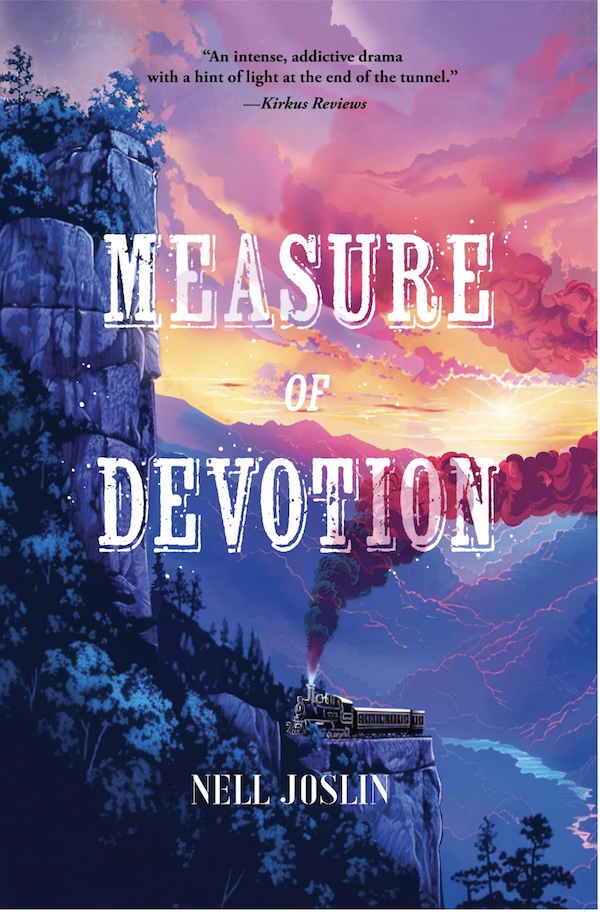 "An intense, addictive drama with a hint of light at the end of the tunnel." — Kirkus Reviews
It is the Civil War, Susannah Shelburne, age 36, is living in South Carolina. Although she and her husband oppose the Southern cause, their only child Francis is a Confederate soldier. When Francis is wounded in Tennessee, Susannah leaves home to find him. Under her care his condition improves, but he soon becomes a prisoner of war, and Susannah strikes a wrenching personal bargain in exchange for his parole. Soon, though, news from South Carolina makes it clear that returning home is impossible, and Francis’s worsening mental state necessitates a high-stakes escape plan.
There is a wildness hidden beneath Susannah’s demure façade, leading her into unconventional, courageous decisions that put her at odds with her husband, her son and her community. Adversity also brings her more fully into the realities of the people of color in her life.
Measure of Devotion’s themes—political differences among families and communities, the urgent need for transracial understanding, a woman’s existential search for control of her own life—are the persistent issues of our national consciousness.
“Measure of Devotion is a debut novel that is bound to enter the canon of classic Civil War literature. That it's told from a woman’s viewpoint makes it unique.” — Hungry for Good Books
Available from Regal House Publishing, Amazon, Barnes and Noble, Bookshop, and your local independent bookseller.
For more, go to measureofdevotion.com
"An intense, addictive drama with a hint of light at the end of the tunnel." — Kirkus Reviews
It is the Civil War, Susannah Shelburne, age 36, is living in South Carolina. Although she and her husband oppose the Southern cause, their only child Francis is a Confederate soldier. When Francis is wounded in Tennessee, Susannah leaves home to find him. Under her care his condition improves, but he soon becomes a prisoner of war, and Susannah strikes a wrenching personal bargain in exchange for his parole. Soon, though, news from South Carolina makes it clear that returning home is impossible, and Francis’s worsening mental state necessitates a high-stakes escape plan.
There is a wildness hidden beneath Susannah’s demure façade, leading her into unconventional, courageous decisions that put her at odds with her husband, her son and her community. Adversity also brings her more fully into the realities of the people of color in her life.
Measure of Devotion’s themes—political differences among families and communities, the urgent need for transracial understanding, a woman’s existential search for control of her own life—are the persistent issues of our national consciousness.
“Measure of Devotion is a debut novel that is bound to enter the canon of classic Civil War literature. That it's told from a woman’s viewpoint makes it unique.” — Hungry for Good Books
Available from Regal House Publishing, Amazon, Barnes and Noble, Bookshop, and your local independent bookseller.
For more, go to measureofdevotion.com Robin Mayer Stein started writing at age five and never stopped. She grew up in Jackson Heights NY, and moved to Boston to attend law school. Her work has appeared in Home Planet News, Fiddlehead Folio and the new renaissance. She received a poetry grant from the Massachusetts Cultural Council. She speaks at schools and libraries about her book, My Two Cities: A Story of Immigration and Inspiration. She loves sharing stories with Stella, Maya, and Liam, her grandkids.
 After forty years in finance, Linda K. Allison is enjoying life as a writer, photographer, and explorer. Her work has appeared in Bright Flash Literary Review, 2023 Utah’s Best Poetry, Pose Anthology, and others. Her photography has appeared or is forthcoming in Burningword Literary Journal, The Sunlight Press, and others.
I like the concise combinations of two: Sam/Mr. Kaufman, no hunger for food with hunger for romance, pothos at home and in Kaufman’s office, playing with the locket/necktie. Thank you.