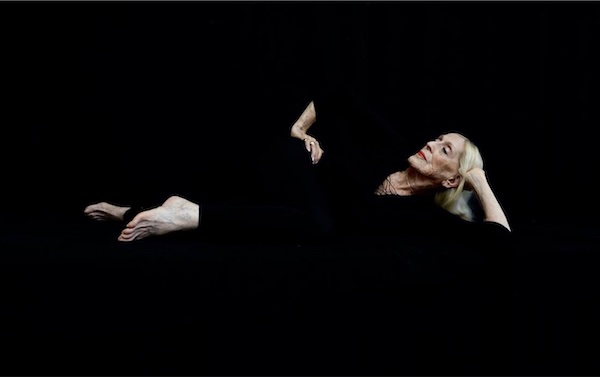
Not only has she not let her age, or the age of her subjects, slow her down; she has recently published a book titled Ageless Dancers, in which she uses photography, a medium that is new to her, to celebrate the transcendent beauty of older dancers’ bodies and their movements.
What a perfect artist for Persimmon Tree!

Sally Hess, photograph by Betti Franceschi.
This photo appeared in the Fall 2024 issue of Persimmon Tree,
illustrating the article “Diplomats of Equilibrium” by Sally Hess
Franceschi’s primary career has been as a traditional visual artist—a sculptor, painter, and draftsman. Most, but not all of her earlier work centered on the human body. Yet she has also made successful still-life paintings and landscapes, and has drawn and painted numerous portraits as well.
The oil painting below is one of the artist’s still lifes. Her delicate and refined touch reflects her love of the vintage china she has collected.

Roses I. Oil on canvas. 18” x 18.” 1983.
This became clear when a colleague and I visited her apartment on New York City’s Upper West Side, in which everything reflects Franceschi’s life as an artist. In fact, the small apartment was recently featured in the Real Estate section of The New York Times.

The artist with part of her meticulously arranged collection of nineteenth-century English china.
Franceschi’s vivid and lifelike portraits are so well drawn that they almost remind me of the work of Jean-Auguste-Dominique Ingres (1780-1867). Below, for example, is her drawing of Abel Bomberault, a mathematician who adored art and artists. He was a close friend of the artist until his death in 1991.

Abel. Ink on paper. 24” x 18.” 1989
The oil painting below is Franceschi’s portrait of a young French actor who was boarding with one of the artist’s friends.

Jean Vincent. Oil/linen. 42” x 30.” 1976.
Both Abel and Jean Vincent are not only realistic likenesses, they also convey a sense of the inner life of the subjects.
Franceschi has also created a number of smaller pencil drawings depicting nude torsos of dancers, such as the one just below:
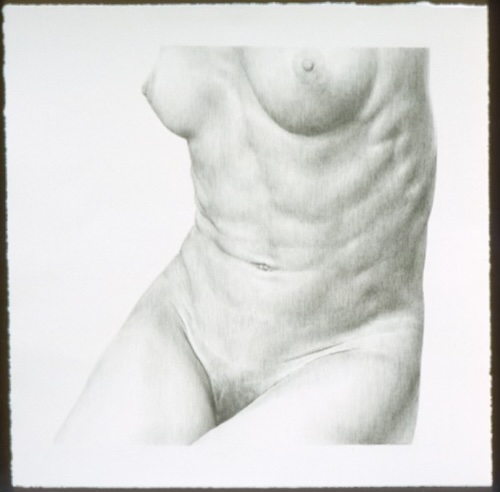
Still Point III. Graphite on paper. 12” x 12.” 1984.
She collected these pencil drawings in a book, The Still Point: Images from Dancers’ Bodies (1987), about which she has written:
I have tried to make visible how it feels and what it means to live in these bodies.
These smaller graphite drawings also gave rise to large oil paintings and pastels, including the two shown below:

Nude I. Oil on Canvas. 50” x 50.” 1990.
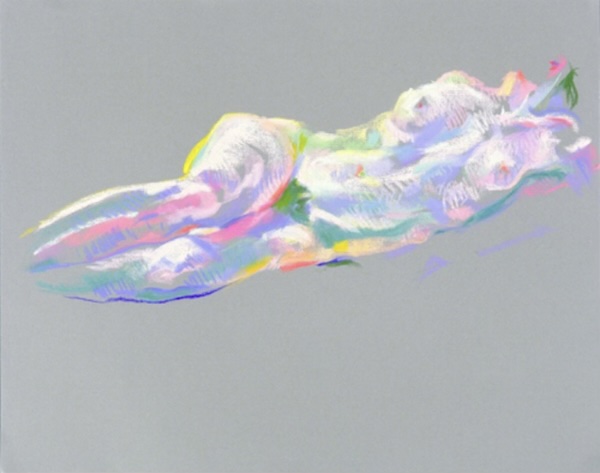
Nude PO9A. Pastel on paper. 24” x 19.” 1982.
About these, Franceschi has written:
Franceschi’s large Montana landscape, below is one revelation of her love of landscape and “movement before movement.”
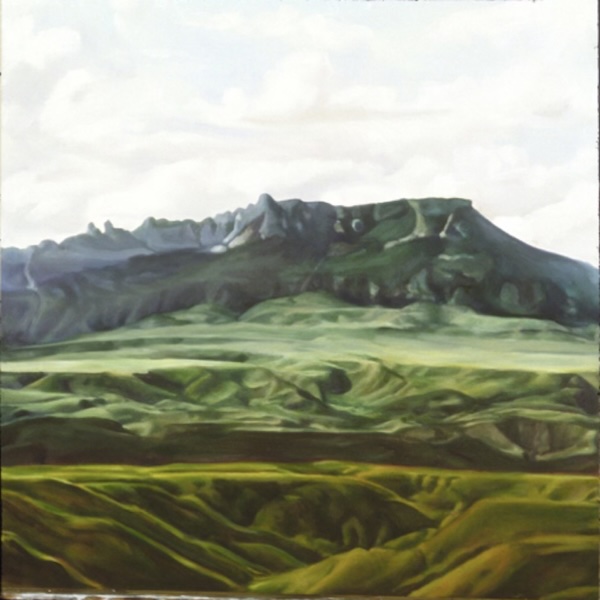
Montana II. Oil on canvas. 26” x 26.” 1980.
The artist has also made a number of unique paintings, such as the one just below. She calls these “signature drawings” because both she and the dancers she depicts sign them. She has said that “the marks of the drawing often have more the character of the dancer’s signature than my own.”

Signature 5F, Linda Kent. Oil crayon on paper. 25” x 19.” 1989.
While these “signature drawings’ have sometimes been called “abstract,” they in fact concretely capture the spirit, movement, and bodies of the dancers. I happened to attend New York City Ballet performances while in the midst of writing this article, and Franceschi’s drawings, especially these “signature” ones, kept appearing in my mind’s eye, including her depiction of NYCB dancer Michael Byers, below.

Michael Byers’ Puck. Oil crayon on paper. 25” x 19.” 1989.
Her studio contains several bronze sculptures, including the torso just below.

Bronze torso, 21 ½” high. 2012.
This three-dimensional creation, like all her two-dimensional work, is an attempt to capture the dancer’s center.
Interestingly, it is only relatively recently that Franceschi took up photography. A photographer friend instructed her in the technicalities, and she proceeded to use the camera as a tool. Her 2023 book, titled Ageless Dancers, contains 70 images of dancers between the ages of 62 and 101. Two of those photos illustrate this article. To see others, visit Franceschi’s website.
Artist Betti Franceschi, as well as the ageless dancers she has captured in photos, represents some of the best aspects of aging: the knowledge of a lifetime, combined with keen observation, a love for all aspects of life, and the energy and talent to keep going.
She has depicted stillness and movement; the potential for movement; and, in short, the vitality of life. Even when a dancer can no longer perform virtuosic movements and extreme stretches, purity and essence remain.
Brava, Betti Franceschi! Bravi, ageless dancers!
 “Duke sauntered across the schoolyard, dragging his feet in the dirt. When he got to the fence on the other side, he slowly turned around, as if afraid of what he might or might not see. I waved. He stared back.”
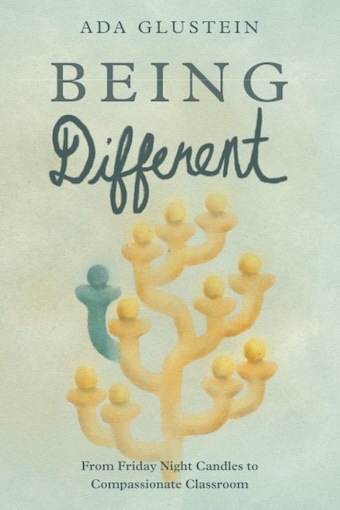
The heart-catching stories in Ada Glustein’s memoir, Being Different, tell a universal story about feeling different and longing to belong. She recounts tales of growing up in a Jewish immigrant family during and following World War II, and the experiences that stand out during her school days, not knowing how to fit in to the world beyond home. She reflects on her years of teaching diverse children who also experienced life as “different.” With her deep understanding of the importance of belonging, as seen through her own eyes and through the eyes of the children she encounters, she finds her own sense of belonging through helping those children find theirs.
Ada’s stories are told with humor and pathos: spilling the wine at her family’s Passover seder; slamming down her books when provoked by one of her Masters at teacher’s college; barely holding in her laughter at the antics of the woman who is housing her during her teaching practicum in a rural school; realizing that she has not included the right flesh color for one of her students to make his self-portrait; clutching three barefoot children outside in a blizzard, while waiting for the alarm bells to stop ringing; and, befriending the class bully to help her know that she, too, is an accepted and valued class member.
These stories remind us to embrace the visible and the invisible differences we all share as human beings on this planet.
Available from Amazon.
“Duke sauntered across the schoolyard, dragging his feet in the dirt. When he got to the fence on the other side, he slowly turned around, as if afraid of what he might or might not see. I waved. He stared back.”
The heart-catching stories in Ada Glustein’s memoir, Being Different, tell a universal story about feeling different and longing to belong. She recounts tales of growing up in a Jewish immigrant family during and following World War II, and the experiences that stand out during her school days, not knowing how to fit in to the world beyond home. She reflects on her years of teaching diverse children who also experienced life as “different.” With her deep understanding of the importance of belonging, as seen through her own eyes and through the eyes of the children she encounters, she finds her own sense of belonging through helping those children find theirs.
Ada’s stories are told with humor and pathos: spilling the wine at her family’s Passover seder; slamming down her books when provoked by one of her Masters at teacher’s college; barely holding in her laughter at the antics of the woman who is housing her during her teaching practicum in a rural school; realizing that she has not included the right flesh color for one of her students to make his self-portrait; clutching three barefoot children outside in a blizzard, while waiting for the alarm bells to stop ringing; and, befriending the class bully to help her know that she, too, is an accepted and valued class member.
These stories remind us to embrace the visible and the invisible differences we all share as human beings on this planet.
Available from Amazon.
 Betti Franceschi was born in 1934 and raised in Cleveland OH. She studied liberal and fine arts, as well as ballet, at Indiana University, Bloomington; fine art at Carnegie Tech before it was Carnegie Mellon; and art history with Rosalind Krauss at Hunter College. Her “Still Point” drawings were published in London as a book, which won six nominations to the National Trust Show in London and Frankfurt, and the drawings were exhibited at, among other venues, Sadlers Wells in London, the National Museum of Dance in Saratoga Springs NY, and the Philharmonic Center in Naples FL. Her “signature drawings” of dancers in motion have been exhibited in several venues, and reproduced on three tee-shirts for the New York City Ballet.
 Greta Berman is Art Editor of Persimmon Tree. She received a B.A. from Antioch College, an M.A. from the University of Stockholm, and a Ph.D. from Columbia. She has recently retired from her position as Professor of Art History at Juilliard, where she taught for 46 years. In addition to writing a monthly column, “Focus on Art,” for the Juilliard Journal, she co-curated and co-edited Synesthesia: Art and the Mind with Carol Steen, at the McMaster Museum of Art, Hamilton ON Canada in 2008. She and Steen also published a chapter titled “Synesthesia and the Artistic Process” for the Oxford Handbook of Synesthesia (Oxford University Press 2013). She has published numerous articles, as well as lectured on synesthesia, and other subjects.
Extraordinary movement and flow in these pieces. They are exquisite. Thank you for your art!
Recently, I had the pleasure of meeting Betti and get a signed copy of her book (actually, two). As a former dancer, I was entranced by her exquisite work
Exquisite and wise work indeed.
Yes, absolutely!
FABULOUS ARTICLE!!!!! I particularly love learning that there are many less well known artists doing exquisite work. You have taught me to look more carefully.
Thanks so much!