

I imagine myself floating onto the stage of a major venue, a vast audience waiting for the opening notes in hushed anticipation. I am calm, elegantly dressed, fully in control. I gracefully place my hands on the keys and a torrent of celestial sounds issues from a flawlessly calibrated piano.
I feel alive in a way which simply never happens in everyday life, as if I am the conduit for a musical intelligence greater than myself. It plays, not I.
The final notes die away. A torrent of rapturous applause issues from the listeners who have risen to their feet as one. They demand an encore, stomping the floor and yelling, “Bravo!”. I oblige.
No way.
The list of my performance humiliations is so long I can’t easily recall many of them. One blessedly forgets. They began in high school. The hands trembling uncontrollably. The out-of-the-blue memory lapses. The flight from the piano teacher’s recital in tears.
A surreal piano supplied by the concert sponsor contributed to my last meltdown: “You will love the piano. It was donated by our board chair and had been in her family for 100 years.” Depressing the keys required the strength of ten. The slightest foot tap sent the damper pedal to the floor, where it rested comfortably throughout most of the concert.
My unhappy performance ended in sporadic clapping.
A concert artist of my acquaintance claims that a competent pianist would be able to overcome such inconveniences and deliver a stellar performance. Good for her. I’m not that person.
Most of the time, in the practice room and on the stage, what I hear in my head is not what emerges through my fingers. The actual sounds are a parody of the glorious symphony in my mind. Poor technique, lack of talent, and a patchwork musical education might explain this. It is certainly not lack of effort.
We amateurs are a magnet for musical entrepreneurs promising an end to our agony. “If you will pay hundreds of dollars for my course (ditto private lessons, ditto workshop), your difficulties will disappear. You too can play like (insert name of famous concert pianist). Trust me.”
Nope. It’s a variation on get-rich-quick schemes.
So why try?
Playing a responsive piano is like driving a Lamborghini in the Grand Prix. There is a sensation of overwhelming speed and power, of freedom, and of transcendent joy. This happens very rarely but often enough to guarantee that I persist in the quest.
Beethoven once said, “Don’t only practice your art but force your way into its secrets, for it and knowledge can raise men to the Divine.”
I’ve signed up for another piano course. Hope never dies.
wonder and horror by merging poetry, prose, and visual art.
 Lynn Goforth makes a living as a freelance concept developer for nonprofits. She turns great ideas into something tangible. Lynn spends her free time playing piano and writing a book-length biography of an 18th-century British world traveler.
 Ziggy Rendler-Bregman is a poet and visual artist living in Santa Cruz, CA. She self-published two collections of poetry and art—The Gate of Our Coming and Going (2015) and Into The Thicket (2023), For more information about her, visit her
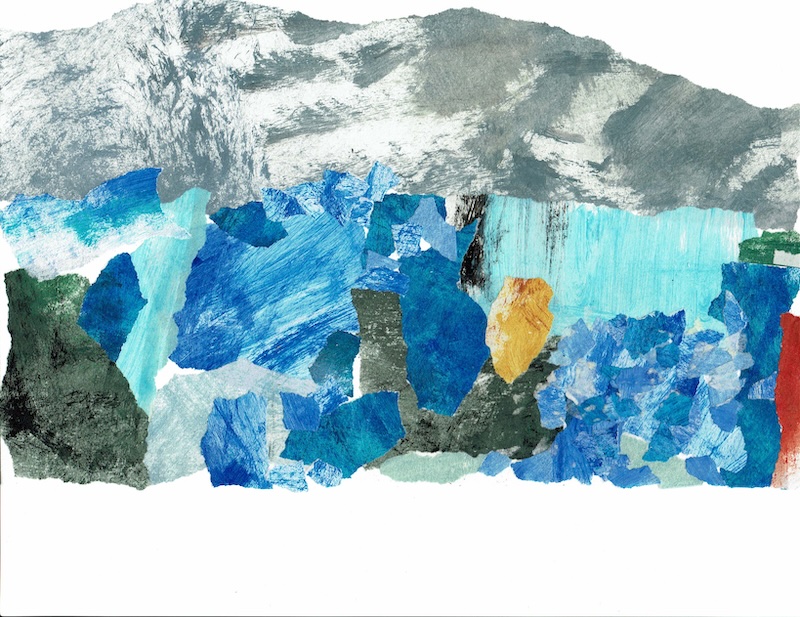
Lynn Goforth’s fantasy about performing on the piano and Ziggy Rendler-Bregman’s inventive collage work together to produce their own kind of music.