
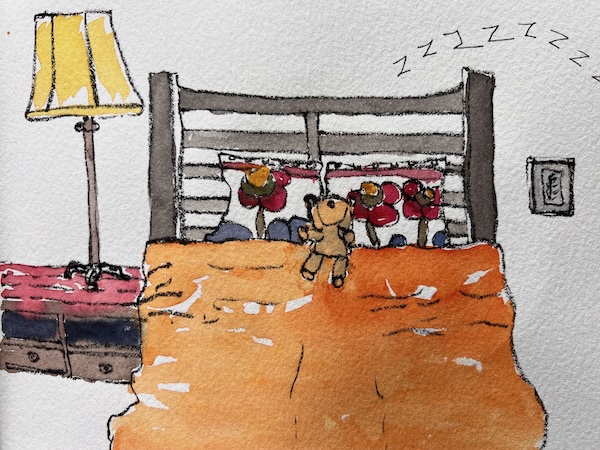

Los Angeles was the city of dreams. Dad dreamed he wouldn’t have to apologize for his long hair and beard, that he could join the counterculture and express himself creatively. And Mom could, too. When we left North Idaho, the first thing they did was cover their clunky Oldsmobile convertible in flowered contact paper. I remember seeing a photograph: the three of us children and Mom, with her blonde bouffant, in front of a flower-covered monstrosity. Lady Madonna, children at your feet.
When he wasn’t pumping gas, Dad took photographs of me and my two younger brothers, and he developed them in a makeshift darkroom. I remember (or possibly dreamed) that room, diffused in a dim, reddish light, photos strung up to dry overhead like festive decorations. Was I perched on a high stool while watching Dad work? There must have been a chemical smell from the developing fluid, stop bath, and fixer, but I can’t say what it was like—maybe it was a dream after all. The details fade but the feelings remain. How magical it was, watching the black-and-white image slowly appear on blank paper. Then Dad moved the photo from the developing tray to the stop bath, and on to the fixer.
I dreamed a child once went searching for his dad to tell him that dinner was ready. He opened the door to the darkroom where his dad was working, and the language that spilled out was tremendous, more colorful than any of the oil paints Dad used on his photographs. I don’t recall the exact words, but the feeling of raw fear—I’d carry that weight a long time.
I dreamed I was an angel, leading a pumpkin and a reluctant petal-less flower. For once, we didn’t have to wear coats over our Halloween costumes when we went out trick-or-treating in the warm autumn afternoon. I remember Mom working on our costumes for days (or maybe weeks). Maybe she used a sheet to make my angel outfit, and wire for the wings. I have a vision of her wrapping orange crepe paper over a round wire frame for my baby brother’s pumpkin suit. She used wire and crepe paper to make the colorful flower petals that she envisioned would surround my other, five-year-old brother’s cherubic face. But he wasn’t having it! He went as a green stalk.
I dreamed I was an artist. Mom must have set up a card table on the patio in front of the trailer house where we lived in North Hollywood. She must have given us paper and wax crayons. I remember it was hot. It was always hot. Maybe I went inside for some Kool-Aid, or to use the bathroom—I don’t remember why I wanted to go inside, but I do remember that I almost stepped, barefooted, on what must have been a potato bug. My heart nearly stopped. Never had I seen such a huge insect. And so ugly. I didn’t know what it was at the time, but the terror it inspired stayed with me; as an adult, I was able to identify the suspect in a line-up on Google images. I don’t remember how long I was in the house, or what I did in there. But I will never forget the disappointment I felt when I went back outside and saw the crayons all melted together in a mess on the card table. At least I think I remember that. Maybe it was a dream. There aren’t any photos of the melted crayons. I guess Dad wasn’t home at the time.
I dreamed of a young married couple arguing, but what about? I couldn’t hear the words, but their echo vibrated through my bones. Was it money? Responsibilities? (He just do what he please!) Maybe self-expression. Mom had dreams of pursuing art, too. She wanted to take a class. And maybe Dad’s drinking was getting out of hand?
I remember Mom did a still life in charcoal—a collection of wooden blocks with dark, elongated shadows. Was this, too, a dream? The scene is blurry and there is no sound. Dad was there, and he grabbed her pencil. Maybe he was saying the drawing was no good. Didn’t anybody tell her? Didn’t anybody see? Maybe he said the perspective was off. He sketched something and jabbed at the paper to make his point. Mom crumpled her drawing. There was shouting—Dad was very expressive—and Mom was crying. The dream was mute, but the fear weighed heavily.
Then I dreamed that Dad went to jail, and Mom was ready to take us back to Idaho without him, back to where we once belonged. Dad swore off alcohol, so we waited for him.
I dreamed we were gypsies living in a tent as we made our way through the desert, back to Idaho and real life. Dad got ajob in the mine and bought us a rickety house near the creek. Ob-la-di ob-la-da. He must have sold his photography equipment because he stopped taking photos. Mom took up oil painting. But she hid her paintings in the basement of the rickety house, along with the boxes of Dad’s old photographs. They were all washed away in a flood. Like nothing was real.
Author's Comment
The reliability, or unreliability, of memory is a theme I have been exploring recently in my writing. It can be hard to sort out which details of our early childhood we truly remember, which we imagine we remember, and which were implanted much later. Through the haze of dreams and faded memories of my family’s time in L.A., the music of the Beatles is a constant thread; it is the soundtrack of my youth.
 What can be gained from listening to music? And what can be learned from songs? More specifically French songs?
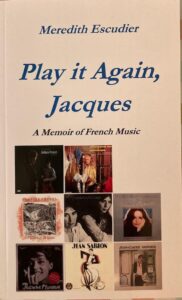
Play it Again, Jacques attempts to answer that question as it traces the life story of an American in France, accompanied, nourished and enriched by the French singer/songwriters she encounters along the way. From composer Michel Legrand and lyricist Jacques Demy – the brilliant creators of the legendary Les Parapluies de Cherbourg – through Charles Aznavour, his intense vibrato ardently portraying the Montmartre of yesteryear, to the contemporary Francis Cabrel singing an ode to Toulouse while managing a nod to the troubadours from the Middle Ages... this book is a tribute to French artists who have made their mark on the author’s sensibilities, expanding and deepening her world by offering up joy, comfort, greater understanding, and charm.
Twenty chapters feature twenty singers who have accompanied her over the years, from the young girl in 1968 anticipating her student year in Bordeaux through 50-odd years into her future after a full and layered life in Paris…from the watchful jeune fille to the more settled grandmother, from youth to gently-aged, from curious and swept away to still curious and liable to be swept away.
In tracing her musical itinerary, Meredith Escudier offers a personal window onto French life and a bridge into contemporary French culture and music. Play it Again, Jacques is for music lovers, Francophiles, or anyone helpless to resist the lure of a musical voyage.
Available on Amazon
What can be gained from listening to music? And what can be learned from songs? More specifically French songs?
Play it Again, Jacques attempts to answer that question as it traces the life story of an American in France, accompanied, nourished and enriched by the French singer/songwriters she encounters along the way. From composer Michel Legrand and lyricist Jacques Demy – the brilliant creators of the legendary Les Parapluies de Cherbourg – through Charles Aznavour, his intense vibrato ardently portraying the Montmartre of yesteryear, to the contemporary Francis Cabrel singing an ode to Toulouse while managing a nod to the troubadours from the Middle Ages... this book is a tribute to French artists who have made their mark on the author’s sensibilities, expanding and deepening her world by offering up joy, comfort, greater understanding, and charm.
Twenty chapters feature twenty singers who have accompanied her over the years, from the young girl in 1968 anticipating her student year in Bordeaux through 50-odd years into her future after a full and layered life in Paris…from the watchful jeune fille to the more settled grandmother, from youth to gently-aged, from curious and swept away to still curious and liable to be swept away.
In tracing her musical itinerary, Meredith Escudier offers a personal window onto French life and a bridge into contemporary French culture and music. Play it Again, Jacques is for music lovers, Francophiles, or anyone helpless to resist the lure of a musical voyage.
Available on Amazon
 Chandra Gair lives in Scotland but was born and raised in Idaho, where her work appeared in several local short-lived publications. She has always liked fiddling about with words and, now that she has retired from teaching, she divides her time between writing and playing with her grandchildren.
 Ellen Agger, living in Victoria, BC, revels in her regular sketching and watercolor. And now in her writing and Feldenkrais movement practices. Pictures and word play, movement and learning, all surprisingly fun and endlessly interesting.