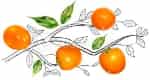
 Family, digital painting by KJ Hannah Greenberg
At the bottom of the last dune lies an artificial lake. Families guide paddle boats in its waters. The adjacent playground is full of children running, screaming, climbing, sliding, and swinging.
I skirt the lake and playground. At last, I walk on asphalt. I count trees. Olive. Oak. Pine. Tamarisk.
Three olives and two tamarisks later, I find the building. A lycium has been planted since my last visit. It nearly threw off my count.
Exhaling in a manner that I hope is inaudible, I walk into the lobby and eye the stairs. The door I seek is on the third floor of this building, a building without elevators. I sigh, again.
Tread over riser, tread over riser, I climb one floor. On that landing, I open my canteen, make a blessing, and sip. My feet throb. My knees hurt. My lower back is spasming. My physical limitations are among the reasons I haven’t sought this address in a very long time.
I cap my flask, say another blessing, make another sigh, and proceed toward the second flight. It has as many steps as did the first.
One by one, I climb them. Despite the heat and glare, my trek across the sand seemed easier.
The apartment’s residents rarely call. They visit me even less frequently. Most of our connections are made at my behest.
I shake my head. I am tired.
Feet can be soaked in Epsom salts. Knees can be soothed with arnica creams. Backs can be adjusted by chiropractors. Heartache, though, cannot be fixed by cardiologists. What’s more, no therapist of integrity can authentically promise to be able to reassemble my broken bits.
I ought not to have had to climb these stairs. They ought to have called. They ought to have visited.
I sit on the bottommost tread of the second flight. They have no knowledge of my trek. They know only snippets about my health. My appearance at their door will be a surprise.
I pull a rag out of a pocket and dab at my eyes. At least some sand gets cleared from them.
Other than an increase in pain, my journey up the second flight of stairs is uneventful. I do not drink more water as I have to save some for my return.
Perhaps I linger on that landing for ten minutes. Perhaps I linger for an hour. There are no windows in the stairwell, so I have no external referent by which to mark my pace.
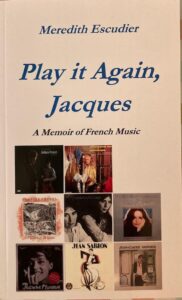 What can be gained from listening to music? And what can be learned from songs? More specifically French songs?
Play it Again, Jacques attempts to answer that question as it traces the life story of an American in France, accompanied, nourished and enriched by the French singer/songwriters she encounters along the way. From composer Michel Legrand and lyricist Jacques Demy – the brilliant creators of the legendary Les Parapluies de Cherbourg – through Charles Aznavour, his intense vibrato ardently portraying the Montmartre of yesteryear, to the contemporary Francis Cabrel singing an ode to Toulouse while managing a nod to the troubadours from the Middle Ages... this book is a tribute to French artists who have made their mark on the author’s sensibilities, expanding and deepening her world by offering up joy, comfort, greater understanding, and charm.
Twenty chapters feature twenty singers who have accompanied her over the years, from the young girl in 1968 anticipating her student year in Bordeaux through 50-odd years into her future after a full and layered life in Paris…from the watchful jeune fille to the more settled grandmother, from youth to gently-aged, from curious and swept away to still curious and liable to be swept away.
In tracing her musical itinerary, Meredith Escudier offers a personal window onto French life and a bridge into contemporary French culture and music. Play it Again, Jacques is for music lovers, Francophiles, or anyone helpless to resist the lure of a musical voyage.
Available on Amazon
What can be gained from listening to music? And what can be learned from songs? More specifically French songs?
Play it Again, Jacques attempts to answer that question as it traces the life story of an American in France, accompanied, nourished and enriched by the French singer/songwriters she encounters along the way. From composer Michel Legrand and lyricist Jacques Demy – the brilliant creators of the legendary Les Parapluies de Cherbourg – through Charles Aznavour, his intense vibrato ardently portraying the Montmartre of yesteryear, to the contemporary Francis Cabrel singing an ode to Toulouse while managing a nod to the troubadours from the Middle Ages... this book is a tribute to French artists who have made their mark on the author’s sensibilities, expanding and deepening her world by offering up joy, comfort, greater understanding, and charm.
Twenty chapters feature twenty singers who have accompanied her over the years, from the young girl in 1968 anticipating her student year in Bordeaux through 50-odd years into her future after a full and layered life in Paris…from the watchful jeune fille to the more settled grandmother, from youth to gently-aged, from curious and swept away to still curious and liable to be swept away.
In tracing her musical itinerary, Meredith Escudier offers a personal window onto French life and a bridge into contemporary French culture and music. Play it Again, Jacques is for music lovers, Francophiles, or anyone helpless to resist the lure of a musical voyage.
Available on Amazon
Only a single flight of stairs separates me from the floor of the apartment. I can still return with no one discovering that I have tried to visit. I sit on the floor and reconsider.
I wonder if they’ll bother to attend my funeral. Likely, they’ll be happy with the monies I am bequeathing to them. Likely, they’ll mourn me, on holidays, and on the anniversary of my death, but only in a perfunctory way.
My homecooked meals have been replaced by social media-posted sups. My careful budgeting of hand-me-downs and discount purchases went the way of Sumatran rhinos when designer togs became within their reach. My decades of emphasizing Hillel’s prime dictate, “what is hateful to you, do not do to your fellow,” was tossed aside as soon as outside influences paid for their apartment, their car, and trips to foreign “destinations.”
I was invited to life events only where photographers would create a record, but not to births. I was welcomed to goings-on when they deemed it convenient but was never asked to fully participate. I was reduced to a mark on their ancestral tree instead of being welcomed as a living legacy or even as an occasional font of life wisdom.
And yet, he is my son. They are my daughter-in-law and grandchildren. I have no other family. They should hear the news.
I climb that last flight of stairs. My sciatic nerve sends pain all the way to my toes. I am breathless upon reaching the third landing.
When I knock, a small human, who looks a lot like my son, answers. In disappointment, he announces, “Oh, it’s Grandma.”
My son comes to the door. He calls forward no other grandchild. My daughter-in-law continues her phone call. I can hear her laughter, but not her words, in the background.
I tell my son the doctor’s prognosis.
He mumbles a few words, offers no hug, kiss, chair to rest on, or refreshment, and then shuts the door.
I sit in front of his apartment for a while, willing myself to take the first steps back to where I dwell. Eventually, I stand up and begin to descend the many stairs. I am returning home.
 KJ Hannah Greenberg's poetry, fiction and paintings have been nominated for The Best of the Net in poetry, The Best of the Net in art, the Pushcart Prize, the Million Writers Award the PEN/Diamonstein-Spielvogel Award for the Art of the Essay. She had had more than forty books published and has served as an editor for several literary journals.
An honest portrayal of what it often means to age in the presence of others, namely adult children and grandchildren, yet become invisible in their present lives.
Agree. I could feel every ache and pain, but moreso, the distance between the author and her son. It’s as if she reached out, and caught only air, when he opened the door.
Truly, a very sad story but beautifully written and leaves the estrangement up to the reader to surmise. Kudos to this author.