Soon, the train plunges from the city into the countryside and I watch the corduroy drills of plowed fields until they disappear into a blur.
The window feels cold against my cheek; I run a finger through the patch of condensation my breath makes before wiping it away with my sleeve.
“Penny for them?” The woman sitting opposite looks up from her knitting.
I feel my cheeks redden but manage a smile in return.
The woman tugs on her ball of wool, which bobs up and down before falling to the floor.
I retrieve it. “There you go.”
“Thanks. I’m knitting a jumper for my granddaughter.” She clicks the needles together metronomically. “She loves blue.”
“Nice.” I flick open my laptop on the table between us and pick up my headphones.
Mrs. Chatty doesn’t take the hint.
“Going back home?” The woman pushes her spectacles back on her nose with her middle finger.
“Yes.” I set my fingers on the keyboard; surely that’ll work.
“Been a while, has it?” Mrs. Chatty winds the wool deftly around the needles, knit one, purl two.
I look around; the carriage is almost empty, except for a couple smooching at the back, giggling every now and then. I can’t even go and get a drink from the bar; the train has trolley service.
“Seven years,” I say. After all, I’ll be unlikely to meet Mrs. Chatty again. Consider it free therapy, I think. “My dad’s ill.”
“Sorry to hear that.” Mrs. Chatty peers over the top of her glasses at me with watery eyes, her fingers continue knitting.
She wouldn’t be if she knew him, I think.
“I lost my partner last year,” Mrs. Chatty says.
“Sorry,” I reply.
Mrs. Chatty stares out of the window. “Looks like rain.”
It’s a big jump from the death of her husband to checking out the weather, but hey, it takes all kinds. I pick up my headphones.
“A blessing of sorts,” Mrs. Chatty opines.
My cell phone rings. I hit answer and cup my hand over my mouth to speak. My breathing becomes shallow and rapid. “Hello.”
“Nothing like leaving it until the last minute, Sis,” Simon says.
I check my watch, “I’ll be there in three hours. Bye.”
Simon hangs up.
My eyes well up; tears meander down my cheeks. I gulp and swallow.
“Bad news, love?”
When I look up, Mrs. Chatty’s face blurs into view.
“I-I didn’t think I cared,” I sniff. “He was always so critical of me.”
“Here,” Mrs. Chatty offers a tissue.
I wipe my eyes, “I was never good enough.”
Mrs. Chatty pauses between stitches and places her hand over mine. “There, there, love.”
The moment is interrupted by the pneumatic puff of automatic doors opening and the appearance of the drinks trolley. “Tea, coffee?” a bored-sounding man asks.
“Two teas, please,” Mrs. Chatty says and smiles at me. “My treat.”
“Thanks.” I repeatedly dunk the tea bag.
“Maggie.” Mrs. Chatty lifts her cup. “Cheers.”
I send a half-smile her way. “Zoe.”
“I’ve been visiting family in London.” Maggie stirs her tea. “I’m off back to Crewe now.”
“You’re from East Cheshire too,” I reply. “I live in London, but I grew up in Disley.”
“I know it well, beautiful countryside and close to the High Peak.” Maggie’s eyes light up with excitement.
I cast a glance at my phone, no new messages. I grasp the cup with both hands; it feels warm and reassuring, like Maggie. “It’s the hills I miss most.”
Maggie nods. “You don’t get scenery like that in London.” “She pauses a second, then: “I’m sure your mum’s proud of a lovely daughter like you.”
“She died when I was a baby.” Bit of a conversation stopper, I think, and hope.
Yet Maggie continues. “Poor love.”
“I guess you don’t miss what you never had,” I say.
“Do you have any brothers or sisters?”
“A brother.” I put the cup on the table. “Ten years older.”
Maggie nods and returns to her knitting.
“We don’t get on,” I sigh.
“You can choose your friends,” Maggie nods, “but your family’s your family.”
I stare out of the window. The fields are saturated, large pools of water forming at their edges. “Mine never liked me. Dad was controlling, and Simon toed the line.”
“And you didn’t?”
On impulse I roll up my sleeve. “Look, my first tattoo.”
Maggie tilts her head to one side and reads aloud, “You’re not the boss of me now.”
“It didn’t go down well,” I say with a bitter laugh.
Maggie stops knitting and swivels her hand to show a tiny turtle etched on the inside of her wrist.
I can’t disguise my surprise as I gaze at the design.
“Youth doesn’t have a monopoly on tattoos, you know.” Maggie laughs.
“Why a turtle?”
“Symbol of resilience and perseverance. I got there in the end,” she says.
“Sounds intriguing.”
“A story for another day,’ Maggie replies. “You didn’t fall out with your dad over a tattoo?”
“No, it was more than that,” I exhale deeply, “let’s say, an unsuitable partner choice.”
“How so?”
“I was home from university one holiday and, thinking dad was away….” I twiddle my finger in a pool of tea on the table. “I invited a friend around. Dad came back early and caught us in the act on the sofa.”
An empty station whizzes past, its name a flash of letters.
“Oops…” Maggie’s voice hisses on the ‘s’ sound.
“He told Sophie to get out.” My heart skips a beat at the memory. “I said, if she goes, so do I.” I stare into Maggie’s eyes, my face deadpan. “He told me to leave my keys on the table.”
“Where did you go?”
“Back to uni.” I unplug my laptop charger and roll the cable into a neat bundle. “We’ve not spoken since.”
“That’s sad.” Maggie stops knitting and brings the needles together before poking them through the ball of wool and popping it inside her bag. “What did you study at university?”
I’m nonplussed that she’s more interested in my subject choice than my sexuality. And that she didn’t ask what happened between me and Sophie. “Philosophy.”
A bing-bong sound over the intercom heralds an announcement: “The train is now approaching Crewe, passengers alighting here are advised that this will be a short stop.”
“Oops, that’s me, better get a move on.” Maggie stands up to retrieve her suitcase, but before she does, she turns to me.
“Bitterness poisons you. Life is short. Forgive your dad and move on.” She touches my arm. “I leave you with something Marcus Aurelius said a long time ago: ‘Let each thing you would do, say, or intend, be like that of a dying person.’ Bye, love.”
I watch her wheel her case along the platform until she’s enveloped in the warm embrace of a tall, attractive woman.
Maybe she has a point.
Author's Comment
A stranger often starts a spontaneous conversation when I’m traveling by public transport. The train, plane, or bus affords an intimate and safe cocoon where a fellow passenger confides a secret or shares a snippet of their life. Tiny seeds of inspiration emerge from these unexpected impromptu connections and grow into fully-fledged tales. I wanted to develop this idea of sharing confidences with a random person into a short story.
In brief, people tell me stuff.
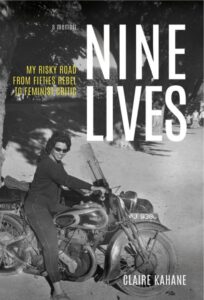 In this tell-all memoir, Claire Kahane, born during the Great Depression to Jewish immigrants, unveils her intimate self-transformations in the course of nine decades. Determined at an early age to prove herself a free spirit in a male dominated world, the young Kahane went on the road, hitch-hiking her way into and out of risky adventures and romantic affairs. But what started out as a “road book” takes a different turn in mid-life when, influenced by a psychoanalysis and the second wave of feminism, she becomes a feminist professor, mother, and wife, dealing with their contradictory demands.
“Claire Kahane has written a memoir for our times: an account of a life spent in pursuit of lived experience long before it was permissible for women like Kahane to do just that. Rich and lively, vivid and bold, Nine Lives is bound to reach a wide and responsive readership.” —Vivian Gornick, essayist, critic, and author of numerous memoirs, including Fierce Attachments, The Odd Woman and the City, and Unfinished Business: Notes of a Chronic Re-reader.
“Claire Kahane’s memoir is a riveting account of a life dedicated to self-discovery. The early part of it involved living dangerously, but her later role as professor, mother, and wife grows naturally from those initial experiences. Her story is also a vivid mirror of the times, from the fifties to the present.” —Robert Alter, translator of the Hebrew Bible and author of numerous books and essays on European and American literature from the eighteenth century to the present, as well as literary aspects of the Bible.
"Claire Kahane's Nine Lives recounts a history of wild wandering and wayward romance en route to self-discovery. A sophisticated scholar of psychoanalysis, Kahane is also a deft writer whose life journey takes her from an immigrant home in the Bronx to motherhood and love, with stops along the way in Mexico, San Francisco, Greenwich Village, Paris, Tangiers, Ibiza--and more. The decades she evokes in her memoir, starting with the fifties and culminating in the present, come vividly to life as she travels the world.” — Sandra Gilbert, poet-critic and-coauthor of The Madwoman in the Attic, No Man's Land, and Still Mad.
Available from Brandylane Publishers, Amazon, Barnes & Noble, Bookshop, and your local independent bookstore.
In this tell-all memoir, Claire Kahane, born during the Great Depression to Jewish immigrants, unveils her intimate self-transformations in the course of nine decades. Determined at an early age to prove herself a free spirit in a male dominated world, the young Kahane went on the road, hitch-hiking her way into and out of risky adventures and romantic affairs. But what started out as a “road book” takes a different turn in mid-life when, influenced by a psychoanalysis and the second wave of feminism, she becomes a feminist professor, mother, and wife, dealing with their contradictory demands.
“Claire Kahane has written a memoir for our times: an account of a life spent in pursuit of lived experience long before it was permissible for women like Kahane to do just that. Rich and lively, vivid and bold, Nine Lives is bound to reach a wide and responsive readership.” —Vivian Gornick, essayist, critic, and author of numerous memoirs, including Fierce Attachments, The Odd Woman and the City, and Unfinished Business: Notes of a Chronic Re-reader.
“Claire Kahane’s memoir is a riveting account of a life dedicated to self-discovery. The early part of it involved living dangerously, but her later role as professor, mother, and wife grows naturally from those initial experiences. Her story is also a vivid mirror of the times, from the fifties to the present.” —Robert Alter, translator of the Hebrew Bible and author of numerous books and essays on European and American literature from the eighteenth century to the present, as well as literary aspects of the Bible.
"Claire Kahane's Nine Lives recounts a history of wild wandering and wayward romance en route to self-discovery. A sophisticated scholar of psychoanalysis, Kahane is also a deft writer whose life journey takes her from an immigrant home in the Bronx to motherhood and love, with stops along the way in Mexico, San Francisco, Greenwich Village, Paris, Tangiers, Ibiza--and more. The decades she evokes in her memoir, starting with the fifties and culminating in the present, come vividly to life as she travels the world.” — Sandra Gilbert, poet-critic and-coauthor of The Madwoman in the Attic, No Man's Land, and Still Mad.
Available from Brandylane Publishers, Amazon, Barnes & Noble, Bookshop, and your local independent bookstore.
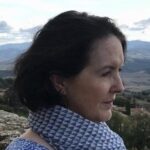 Belgium-based writer Sheila Kinsella’s short stories draw inspiration from her Irish upbringing. An avid watcher of people’s behavior, and blessed with abundant natural curiosity, she lures the reader into a shrewdly observed world via imagery and comedy. Sheila has had more than thirty short stories published since she graduated with an MA in Creative Writing (Distance Learning) from Lancaster University in the United Kingdom in 2017. She is currently working on a novel.
 Judith R. Robinson is an editor, teacher, fiction writer, poet and visual artist. A summa cum laude graduate of the University of Pittsburgh, she is listed in the Directory of American Poets and Writers. She has published 100+ poems, five poetry collections, one fiction collection; one novel; and edited or co-edited eleven poetry collections. She teaches in the Osher program at Carnegie Mellon University and the University of Pittsburgh. Her newest poetry collection, Buy A Ticket, was published this year, and is available from Amazon. Her latest gallery exhibit was in September 2021 at the Square Café in Pittsburgh.
Economical story with depth. Enjoyed it.
I loved getting a short story this morning in the mail and read it first thing. Yes, I enjoyed the intimacy between these two strangers. Nice to wake up to kindness and empathy.
Loved this story– and the idea of stirring up stories.
Lovely story. Sometimes strangers are more understanding than someone we know.
Bitterness/hate uses too much energy. Forgiveness is difficult.
Hi Sheila, Excellent observation of strangers, their conversation and connection. Gently revealed. Train rides provide these opportunities.
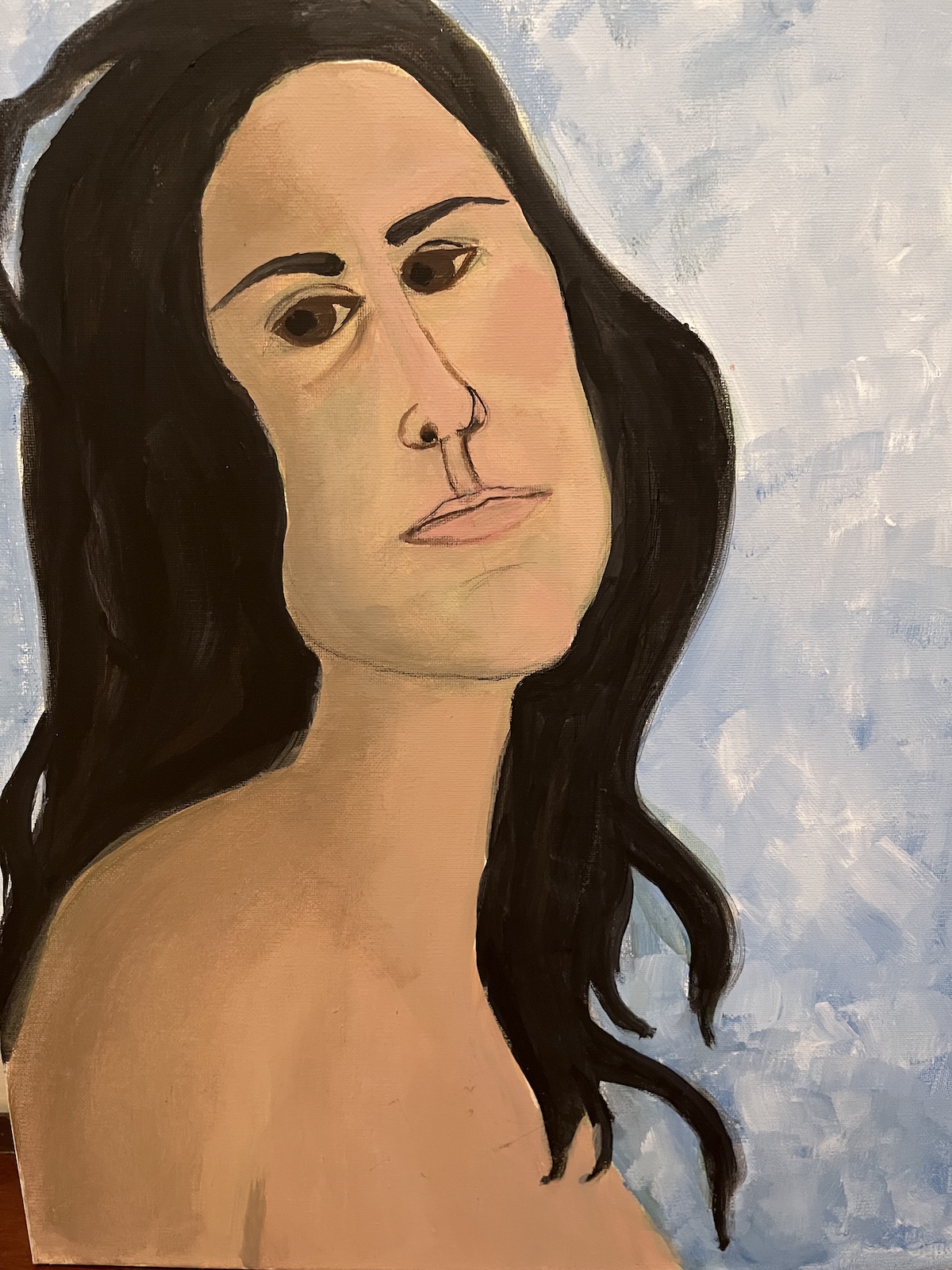
Beautifully tender portrait of “Monica” to partner with this engaging story, by Judith R. Robinson.