The tremor that passed through me that day was the last vestige of childhood falling away. The promise of adulthood beckoned as the campus I would come to love emerged beyond our car window. Now decades later, as I pull into a parking space behind a dorm I’ve never seen before, on a campus I don’t recognize, the familiar tremor passes through me again.
Before checking the box “I will attend ” on the 50th reunion invitation, I asked myself the usual questions—How will I measure up physically to my classmates? How will I measure up on the success-o-meter?—and then I made the usual upgrades: nails, hair, wardrobe. I was prepared for the changes my classmates would see in me, and I in them. But the massive transformation I was encountering on the campus I had not foreseen.
“Which of these buildings is the library?” I asked one of the staff hosts. How was it possible I didn’t know? A glossy brochure, folded and shoved into the front pocket of my purse, promised a book give-away for visiting alumni. Near the library, an unexpected arched wooden arbor enticed me into what a sign identified as the Shakespeare Garden. I followed a peaceful stone pathway meandering among the literary plants. As the path curved to the left, a familiar building, my freshman dorm, previously hidden by bigger, newer buildings, appeared in my line of vision. I gasped. Easing onto a weathered wooden bench, I gave myself over to a surge of memories.
In the concert hall on the left side of the building, I gave my senior recital. I played Chopin and Debussy that afternoon so long ago, and dreamed of a career as a professional musician. In a second-floor dorm room in this same building, my first love kissed me, our first kiss, and all the dreams I ever dreamed about love suddenly made sense. I turned away from the dorm, and looked at an engraved metal plaque fixed to the back of my bench. “We are such stuff as dreams are made on…” (The Tempest).
As I ambled out of the garden, the churning that had been gnawing at my insides on and off all day reinvigorated itself. The demolished dorms, classrooms, halls, and pathways had been my witnesses, uniquely bonded to my identity. In those places I had forged my sexual, professional, and artistic self, became the person I am. I shivered in the warm afternoon air. The dramatic changes on the campus were more than a shock; they were a trigger. I had experienced this feeling of unexpected loss before. My jaw clenched and a whoosh of gut-memory thrust me backward to that July morning two years prior.
She had been my partner for 25 years. We bought a home together and married as soon as the laws allowed. Our shared interests and careers had evolved side by side, and I was full of anticipation for the post-retirement stage we were about to begin. On the morning she left, our car was packed and ready for the journey to our summer cottage. I was in the shower. By the time I dressed, she was gone. And now, two years later, the unexpected disappearance of a few buildings unleashed the ghosts, reopened the wounds, and catapulted me back into the nightmare.
Why do humans have so much trouble with change? Maybe because we’re creatures of habit who find it uncomfortable to be forced from our routines. Or maybe it’s the uncertainty we abhor. For me, the most challenging aspect of change is its inherent loss—loss of control or at least the fear of it. And then there’s the fear of the ripple effect a single loss can propel into all corners of life, like ever expanding circles in a pond. After she left, I dreaded the emptiness of holidays, travel, mutual friends, anything we had shared. I missed her at the Thanksgiving table, and longed for her when I flicked on the Christmas tree lights. I missed entertaining together, not so much the actual party, but the time we’d spend preparing the house and the food, and then after, sitting close, sipping the last drops of wine, staring at the dying embers in the fireplace while rehashing the evening. I resented, most of all, the loss of our summer cottage, the cottage we were headed to the day she left.
Grist Mill Cottage was our place—not really ours, we rented it, but it felt like ours—nestled in the North Carolina mountains, overlooking a white-water river, a haven of birdsong and inspiration. We rushed there every summer to escape the demands of our careers, to be alone together. For months after she left, the mere thought of the cottage made my stomach writhe. Everything about that place was too tightly woven into my life with her to ever imagine returning without her.
But return I did. The decision came suddenly, on an early morning walk after a restless night. Some dark, shapeless thought I couldn’t grasp or shake lurked behind me. I walked quickly, in an effort to escape it. The rage I had tamped down for a year was at my heels, and from its molten center, the idea exploded like a thunderbolt: I will decide for myself if the cottage is no longer good for me. I will decide for myself to give it up and begin searching for another place; or I will decide for myself to keep it—but SHE CAN’T TAKE IT AWAY FROM ME! I stopped walking, stopped breathing, frozen by the truth: she can’t take it away from me. I began walking again, slowly at first, then very quickly, propelled by a surge of energy. Enough energy to imagine life beyond loss.
Scientists have long known adapting to change is the secret of survival. We need to flex our adaptive muscles so we can cope with life’s sudden shifts—divorce, illness, pandemic. Experiencing unexpected changes in life teaches us to be resilient, as long as we remain conscious of our own capacity for growth and learning.
I never made it to the library that day, and I don’t remember how long I walked around the campus or in what direction I wandered, but eventually I found myself standing in front of a sculpture entitled Emerging created by a Pennsylvania artist, Jay Dugan.
Four large Italian marble slabs, each approximately eleven feet high, stood aligned one behind the other. The slabs fanned out to the right, creating the impression of progression. The artist’s clear intention was to represent a student’s evolution from freshman through senior year. As I viewed the work from left to right, the abstract design on the core of each stone became more refined, sharpened and complete. Like most students, I was unaware of the changes being wrought in me during those years. Even now, I’m rarely aware of my own transformations in the moment.
Whether traumatic or planned, dreaded or anticipated, change is an act of creation from destruction, like the phoenix rising from the ashes. All change has the same purpose: to make something new. It’s not important to know the “something new” at the moment of change—only to know that something new is imminent and that it is the reason for the change. Looking back on a lifetime spanning three quarters of a century, I can’t think of a single instance when I was unable to transform the “something new” into something better. What will the senior do with her education? What will I do with my cottage?
In previous summers, our cottage had served as a sort of adult summer camp, a place for hiking, swimming, tubing, but I preferred to think of it more like a retreat. So when I returned alone, I brought a pad of paper, a laptop, and the desire to write. A small screened-in porch off the master bedroom, with a tiny bistro table and two chairs, became my office, a treehouse office overlooking a white-water river and a garden. We had never used this porch; we spent our time on the larger one where we ate our meals, entertained our guests, and lazed with books in wooden rocking chairs. The treehouse office had no memories attached.
I was drawn to my treehouse every morning, drawn by the chirping and buzzing, by the sunbaked scent wafting up from the garden below, by the rush of the Rocky Broad River. I was drawn to the pleasure of releasing everything onto the page. Despite my fears, the end of my marriage did not stop the process of my becoming.
Standing there before the campus sculpture, I considered my transformation over the past two years. Like the senior stepping out of the fourth slab, still unfinished but more refined, I finally grasped the concept–the mechanism of becoming is change, and change is about more than loss; it’s about making something new.
Author's Comment
I continue to visit my cottage every summer, my private writing retreat, where I spend my days seeking a deeper dimension of myself in solitude, on a hiking trail, in the woods, or facing a blank page in my treehouse office. This summer, I plan to complete my first book, a memoir. Life never stops giving.
 Flashlight in the Fog holds twenty short stories, micro, flash, and longer tales of romance, fantasy, and dark, dark, dark fiction put to the page. Peek into the mind of a magician, a bride-to-be, a traveler, and more. Explore their themes of adventure, cultural misadventures, and coming to terms with life’s span from coming-of-age to aging.
All have been previously chosen for publication in online magazines and anthologies, and are now compiled here in one volume.
When you have just a few minutes or an hour to spare, whether you’re in the mood for a laugh, a cry, or some goose bumps, reach for this collection with more engaging stories from the author of Unintended Consequences.
Author Patricia Ann Bowen has published a medical time travel trilogy, a short story collection about women in challenging circumstances, and a serialized beach read. Her short stories have appeared in several anthologies and numerous online publications. She’s taught short story writing in the Osher Lifelong Learning Institute (OLLI), and launched and led The Retro Writers, a critique group of short story writers for the Atlanta Writers’ Club. She resides on a small island in South Carolina, has four sons, grandkids all over the world, and two cats in the yard.
You can connect with her and her other work at www.patriciabowen.com.
Flashlight in the Fog is available from Amazon.
Flashlight in the Fog holds twenty short stories, micro, flash, and longer tales of romance, fantasy, and dark, dark, dark fiction put to the page. Peek into the mind of a magician, a bride-to-be, a traveler, and more. Explore their themes of adventure, cultural misadventures, and coming to terms with life’s span from coming-of-age to aging.
All have been previously chosen for publication in online magazines and anthologies, and are now compiled here in one volume.
When you have just a few minutes or an hour to spare, whether you’re in the mood for a laugh, a cry, or some goose bumps, reach for this collection with more engaging stories from the author of Unintended Consequences.
Author Patricia Ann Bowen has published a medical time travel trilogy, a short story collection about women in challenging circumstances, and a serialized beach read. Her short stories have appeared in several anthologies and numerous online publications. She’s taught short story writing in the Osher Lifelong Learning Institute (OLLI), and launched and led The Retro Writers, a critique group of short story writers for the Atlanta Writers’ Club. She resides on a small island in South Carolina, has four sons, grandkids all over the world, and two cats in the yard.
You can connect with her and her other work at www.patriciabowen.com.
Flashlight in the Fog is available from Amazon.

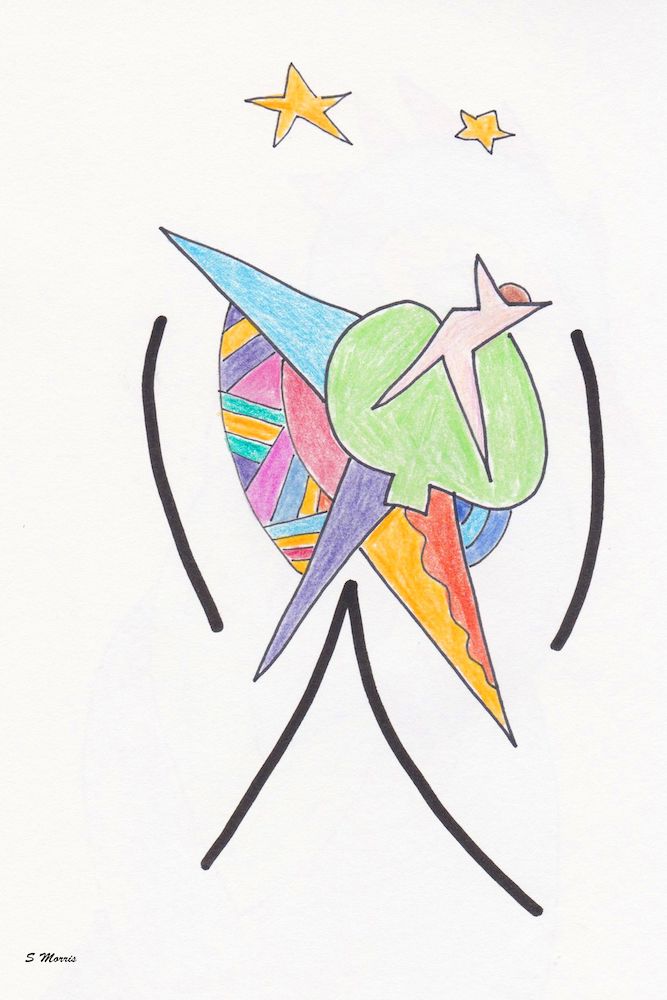
 Sandy Morris, a native New Yorker, moved to Greenwich Village in the 1960s. With recognition and support from other artists, her work was shown in New York galleries, and since she moved to California, has been featured in galleries and shows in San Francisco, Marin, Sonoma, Alameda Counties, and has won awards in juried exhibitions. Her pen, ink, and pencil drawings usually start with no preconceived idea — just drawing a straight or curved line or two. From there, her imagination takes over as she builds upon the piece. Her works range from the whimsical to the political, to depictions of the emotions, and everything in between.
Loved your essay. After I finished it my first thought was that I wanted to read more.
Thank you, Eileen. We’ll have to plan another walk/lunch when I return from the cottage in Sept.
I am interested in reading your book. Thought provoking detail and depth of feeling
Thanks Sue. The book is progressing but it’s taking FOREVER!! If I ever get it off the ground, I’ll let you know!
Bravo dear friend and neighbor. It took much courage and intense reflection to write this lyrical piece of self discovery and self sufficiency.
Thank you, Angela, for your kind words. And you are so right–courage and years of reflection.
So wise, beautiful and haunting.
Thanks Marge, for reading and commenting. Aren’t we due for a phone date?