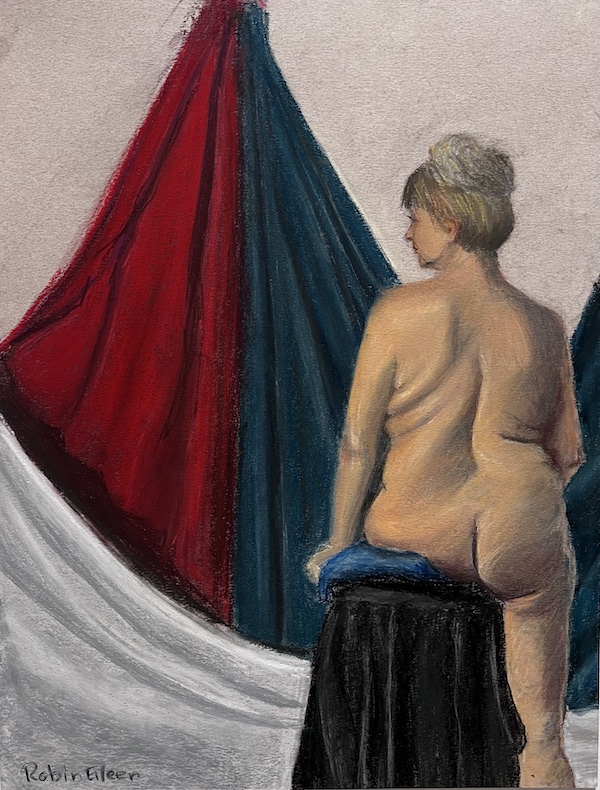

Betty: Room 108
Besides my legs, I have another problem. Debby, my daughter. We’ve been what the social worker called “estranged” for ten years. We fought all the time, even before she could talk: she didn’t want me to change her diaper, dress her, or feed her. And for the next forty-five years that was how we got along. Fight, make up, fight. Over everything. I guess we’re both a little on the controlling side. That’s what Al always said. But once he was gone, that was it— a free-for-all.
Now I’m feeling like I should make one more attempt to make up with her before I die, which can’t be that far down the road. I’ve been sitting out here under the oak tree in the Memory Garden of my new home, one of its selling points, fingering the edge of my tablet, thinking of what to write.
But it’s time for lunch and I’d better drag myself inside. Except for breakfast, almost every meal includes noodles. They have barrels of them in the storeroom. I snuck in there one morning, hoping the cook had a bottle of gin stashed somewhere, but no such luck. We do get a thimble-sized glass of wine at Sunday lunch, but all I would need to die happy today is an icy gin and tonic.
And a letter from my daughter. That would work, too.
Mail call is after lunch, which mostly involves another card for Larry, Room 110. I want to ask him what he did as a dad to hear from his daughter so often, but am afraid to. I don’t really want to think about all the stupid stuff I did as a mom. I never hit my kids, but I did yell. A lot.
My last fight with Debby was in the kitchen. I was telling her how to wash the dishes, supervising, and she turned on me.
“I hate you,” she said and walked out the door.
Now, I know it wasn’t over the dishes. We’d fought over how to do things for years— especially kitchen stuff. Once I had her and Ron over for dinner and she turned up her nose at the casserole I’d made when I set it on the table.
“Fine,” I said and picked it up, dumped it into the garbage, went into the living room, and turned on the TV. That’s how it went, until the last one over the dishes.
What I do know, what my son has told me, is that Debby and Ron split up and that my son sees her around town quite often with the same woman. Has she turned gay and is afraid to tell me? For ten years? I don’t care. I mean whatever you are, you are. Maybe I should write that to her. Give her an opening. But would that offend her? And what if I’m wrong? You can see what a problem this is.
So, after lunch—peas, noodles, and bits of chicken—I’m back in the garden on the other side of the tree to avoid the afternoon sun. Larry is headed my way, bent over his walker like we all are, wearing one of the ten ironed plaid shirts he likes to brag about. He does use deodorant, a plus for the rest of us.
“Hey, Betty, how are you doing?”
“How do you think I’m doing? I’m still here.”
“Oh, cheer up,” he says, and plops down in the lawn chair next to me.
In his shirt pocket is what looks like the usual greeting card, unopened. “Hear from your daughter today?” I ask, knowing what the answer will be.
He nods, takes the card out of his pocket, and hands it to me.
“What,” I ask, “your eyes don’t work anymore?”
“I need your advice,” he says. “Read the card.”
“You want me to open it and read it?”
“Yes,” he says. “Open it.”
The cover of the card is inscribed “To a Dear Dad,” the words surrounded by a bouquet of lilacs. I hesitate.
“Open it,” he says again.
I do as ordered. Inside, the sentimental poem is scratched out in black ink, and “I hate you”—written in red ink— covers the white spaces. I’m shocked. I don’t know what to say, which is unusual for me. “You get one of these every day?” I hand it back to him.
“I do. Every day. I don’t know what to do.”
After swearing me to secrecy, he tells me his story. His daughter had turned on him when he refused to give her money to bail her son, his grandson, out of jail.
“The kid’s a drunk,” he adds, “on his third DUI. I thought some jail time might make him change his ways, before he kills himself or somebody else. I lie in bed at night with a knot in my stomach, worrying.” He wipes his eyes with a neatly pressed handkerchief.
Now I’m nervous. I can’t handle crying old people. Not even myself. Time to change the subject.
“Who irons your clothes?” I ask. “They sure do a good job.”
“I send my laundry out,” he says, and straightens the collar on his shirt. “Are you writing something?” he asks, nodding toward my tablet. “About the joys of getting old?”
“No, just a letter.” I want to tell him about my problem but don’t want people gossiping about me. Fortunately, I need to pee and tell him so, a bit more politely.
“Me, too,” he says.
Both grunting as we hoist ourselves out of the lawn chairs, we head inside.
 Older Wiser Shorter is an intimate collection of 89 poems from Jane Seskin, a working psychotherapist and author. Seskin, authentic, funny, insightful, quirky and heartfelt, acknowledges the disappointments, physical vulnerability and emotional loss taking place in her senior years. She is able to discover within herself a solid sense of power, resilience and new-found joys through her struggles to acknowledge, accommodate and accept her aging. Seskin's ability to make the very personal universal, will resonate with readers seeking to discover new ways to honor the past, celebrate the present and welcome the future. A Reading Guide to the poems will inspire further reflection and discussion for book and women's groups.
Praise for Older Wiser Shorter:
“Even tho I’m not a fan of poetry, I found Jane Seskin’s poems to be a delight. They hit home.”
— Jane Brody, former Personal Health columnist, New York Times
“I sat down to read one poem last night and I ended up reading half the book. I feel as though I know you. You have definitely captured the experience of aging.”
— Mary Pipher, author of Women Running North and My Life in Light
“Candid, funny, and best of all inspiring, the poems in Jane Seskin’s Older Wiser Shorter throw open a window on aging. Suddenly a breeze of resilience sails through. I learned from Seskin’s poems; they became like mentors for the strange adventure of late-life living. Kindness infuses them. The ‘enormous optimism’ of this intrepid book might prove the greatest wisdom of the ages.”
— Molly Peacock, author of The Analyst
Older Wiser Shorter is an intimate collection of 89 poems from Jane Seskin, a working psychotherapist and author. Seskin, authentic, funny, insightful, quirky and heartfelt, acknowledges the disappointments, physical vulnerability and emotional loss taking place in her senior years. She is able to discover within herself a solid sense of power, resilience and new-found joys through her struggles to acknowledge, accommodate and accept her aging. Seskin's ability to make the very personal universal, will resonate with readers seeking to discover new ways to honor the past, celebrate the present and welcome the future. A Reading Guide to the poems will inspire further reflection and discussion for book and women's groups.
Praise for Older Wiser Shorter:
“Even tho I’m not a fan of poetry, I found Jane Seskin’s poems to be a delight. They hit home.”
— Jane Brody, former Personal Health columnist, New York Times
“I sat down to read one poem last night and I ended up reading half the book. I feel as though I know you. You have definitely captured the experience of aging.”
— Mary Pipher, author of Women Running North and My Life in Light
“Candid, funny, and best of all inspiring, the poems in Jane Seskin’s Older Wiser Shorter throw open a window on aging. Suddenly a breeze of resilience sails through. I learned from Seskin’s poems; they became like mentors for the strange adventure of late-life living. Kindness infuses them. The ‘enormous optimism’ of this intrepid book might prove the greatest wisdom of the ages.”
— Molly Peacock, author of The Analyst
The next morning, at 3:17 a.m., my usual wake-up time, I’m thinking about Debby and Larry, and about my husband. I ask him to tell me what to do. I don’t know if he’s up there, wherever there is, but like to think that I’ll see him again. And then, as I’m dragging myself back to my bed from the bathroom, it comes to me. Nurse Jenny. I should ask her to write a letter to Debby for me. Put her return address on the envelope. Larry could do the same.
After breakfast, I knock on his door.
No answer.
I knock again. He wasn’t at breakfast, but that wasn’t unusual.
“Larry?”
No answer. He’s probably having a nap. We all nap at any time, even over our noodles.
At ten, time for The Price Is Right, Nurse Jenny comes into my room and closes the door behind her.
“I just wanted to let you know,” she says, “that Larry died last night, in his sleep.”
“Well, that rat.” I say, and mute the TV, swallowing my tears. “We were working on a solution to our problems with our kids, and a good idea came to me during the night.”
“What was that?” Jenny sits down on the edge of my bed. She looks tired, exhausted really, doesn’t have on her usual make-up.
“Have a bad night?” I ask.
“Please don’t repeat this,” she says and pulls a tissue out of her pocket.
I nod. Please, no tears.
“It’s my son. We just found out that he’s gotten into drugs again. I don’t know what to do anymore. Last night, my husband kicked him out of the house. It was awful.”
“Oh, Jenny, I’m so sorry. You’re such a good person.”
“Thanks,” she says and wipes her eyes as her call bell beeps. “See you at lunchtime.”
Could I ask her to write a letter for me? I don’t think so. She has enough of her own problems.
By early afternoon the rain has stopped. I turn off the TV and drag myself out to my usual spot in the garden. It’s cold and rain drips from the oak leaves above me, but I open my tablet, shield it with my sweater, take a deep breath and begin:
Dear Debby,
Please forgive me for all the mean things I said to you over the years.
I’m so sorry. I miss you.
Love,
Mom
Before I can change my mind, I drag myself inside, find an envelope and a stamp and drop it into the mailbox.
 Carol Wobig spent a few years in a convent and many more years working in a pizza factory before she retired and started writing. A long-time member of the Redbird Writing Studio in Milwaukee, Wisconsin, she won Honorable Mentions in the Lorian Hemingway Short Story Contest, and in two Writer’s Digest Competitions. Her monologues were performed in community theater and her stories attracted fans in Gray Sparrow Journal and Clapboard House Literary Journal and on Wisconsin Public Radio’s Flash Fiction Friday. Her Collected Stories were published in 2017 by Hidden Timber Books.
  Robin Eileen Bernstein is an award-winning writer in New York whose byline appears in The New York Times, Washington Post, Boston Globe Magazine, Salon and elsewhere. She studies figure drawing at the Art Students League of New York and sells her photography online at Stockimo. She’s working on a memoir. More at
Carol, I hear these sad stories over and over again. Parental embarrassment seeps out with a glass of wine or two. You captured that people carry these secrets – sometimes to the grave. They think they are the only one. Thank you so much spinning this story into the world.
Thank you, Kathleen.
Beautiful and relatable story, Carol. I have always enjoyed your down to earth and gentle unfoldings of our human experiences.
Thanks, Nancy. I miss you and your writing.
Heart-wrenching, in the best possible way. So well done! Kudos, Carol.
Thanks, Pam.
A very thought-provoking piece. My parents both passed away long before their time, my dad at 41 and my mom at 62. But this piece made me think that this tragic state of family affairs–estrangement from one’s children–is much more widespread than most of us know. Your story will motivate me to hug my two kids–both now grown adults–all that much tighter next time I see them. Thank you.
Thank you, Bob. Life is short not matter what. Hugs are important.
Wonderful short story, Carol! So evocative, and you nailed it.
Thank you, Anne. I’m happy you enjoyed it. Hope to see you again, sometime.